Dialectic of Enlightenment shows how the culture industry turns us into consumers — a sharp take on capitalism, curiosity, and Gen Z.
What Is the “Dialectic of Enlightenment” and Why Does It Matter?
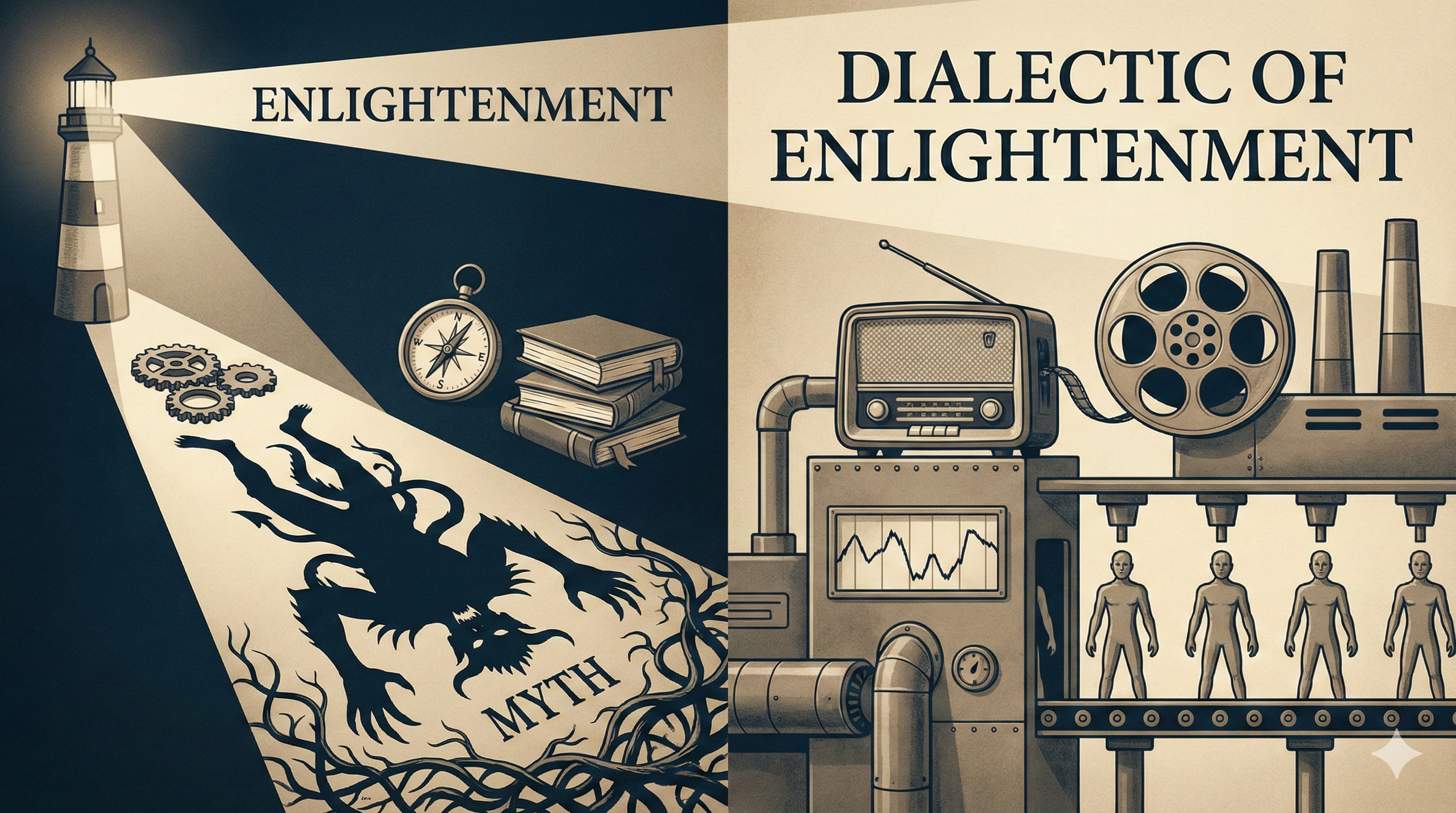
Dialectic of Enlightenment is a critical theory text by Max Horkheimer and Theodor W. Adorno that argues modern reason and mass culture can reverse into domination rather than liberation. They coined “culture industry” to explain how popular culture becomes standardized products that pacify people rather than provoke thought.
Why Does the Culture Industry Still Describe Our World?
The authors argued that mass-produced culture creates “false needs” that can only be satisfied by buying more products. Today, platform algorithms optimise engagement and repeatable formulas — not surprise, not deep curiosity — because predictability equals profit. Studies of streaming platforms and algorithmic personalisation show companies deliberately design content pipelines that appear diverse but follow repeatable patterns.
“You are not the customer. You are the product.”
Why Everything Feels the Same: Standardization of Culture
Ever notice how most Netflix shows have identical pacing, aesthetics, and “relatability”?
Or how TikTok trends recycle every three weeks?
Or how every pop song sounds algorithm-approved?
Adorno called this standardization—where culture is optimized for safe, repeatable profit.
Today, platforms reward whatever keeps people on the app, so:
- Plots repeat
- Sounds repeat
- Aesthetics repeat
- “New” trends are nostalgia repackaged
In a capitalist, consumerist system, standardization reduces risk and maximizes profit—even if it slowly kills creativity and curiosity.
“When everything becomes a commodity, nothing feels meaningful.”
Pseudo-Individualism: Be Yourself (But Buy the Same Things)
The culture industry knows people don’t want to feel identical.
So it sells pseudo-individualism—the illusion of uniqueness inside a standardized system.
Pick your aesthetic:
Cottagecore, clean girl, dark academia, gamer, minimalist, tech bro.
Pick your identity:
MBTI type, “neurodivergent aesthetic,” digital persona, personal brand.
Pick your authenticity package:
That daily vlog, that niche influencer, that curated playlist.
But behind the illusion, we follow the same templates, buy the same products, and live inside algorithmic feeds designed for mass conformity.
Our individuality becomes a marketing segment, not a rebellion.
“Mass culture makes us believe we’re choosing, even when everything is chosen for us.”
How Consumerism Kills Curiosity
One of the most painful insights from Dialectic of Enlightenment is that modern enlightenment becomes its opposite.
We live with infinite information.
We could learn anything.
But mostly we:
- Rewatch comfort shows
- Scroll the same three apps
- Buy slightly different versions of the same products
- Chase productivity hacks instead of purpose
Curiosity is dangerous to the culture industry.
A curious mind asks:
- Why do I want this?
- Who benefits from my attention?
- Why does everything feel the same?
Instead, capitalism turns curiosity into a commodity:
- Buy this course.
- Buy this app.
- Buy this experience.
- Buy this identity.
“Curiosity becomes just another product“
Gen Z, Millennials, and the New Culture Industry
Gen Z and millennials are both the most aware and the most captured generations. But the Irony Is:
- We critique capitalism while building our identities inside it.
- We mock influencers while becoming micro-influencers.
- We hate ads but scroll platforms funded entirely by ads.
- We want authenticity but consume algorithmically optimized “relatable content.”

Our creativity is monetised.
Our rebellion is branded.
Our identities are commodified.
We’re living inside the exact system Adorno and Horkheimer warned us about.
“If you’re not paying for the product, you are the product.”
So What Now? Reclaiming Curiosity in a Culture of Consumption
This isn’t about becoming anti-social or anti-technology.
It’s about agency.
Here are small practices that resist the culture industry:
- Choose intentionally—don’t let autoplay decide.
- Schedule offline time for boredom, reading, creating.
- Support independent artists and non-algorithmic spaces.
- Ask before buying: Do I want this or was I trained to want this?
If the culture industry turns everything into a commodity, reclaiming your attention becomes a radical act.
The real question isn’t “What should I watch next?”
It’s:
Who am I becoming while I watch?
“The culture industry doesn’t ask you to believe—just to not question.”
Read the free Dialectic of Enlightenment e-book here:
Adorno and Horkheimer’s Dialectic of Enlightenment
FAQ
1. What is Dialectic of Enlightenment in simple terms?
It’s a critique explaining how consumerism and capitalism turn culture into standardized products, reducing genuine curiosity and individuality.
2. How does the culture industry affect Gen Z and millennials?
Through algorithmic feeds, influencer capitalism, and passive consumption, it shapes identity, desire, and attention, often without us realizing it.
3. What is pseudo-individualism in social media culture?
It’s the illusion of uniqueness—choosing aesthetics or identities that feel personal but are shaped by trends, platforms, and targeted advertising.
4. How does capitalism kill curiosity?
It redirects curiosity into consumption: courses, apps, products, and branded identities—keeping exploration inside profit systems.
5. Why does modern culture feel standardized?
Platforms optimize for what’s profitable and predictable, resulting in repetitive content, recycled aesthetics, and mass-produced entertainment.